How to view a solar eclipse without glasses
You can watch the partial phases of a solar eclipse without glasses by projecting the Sun, never by looking at it. The only time you may look straight at the Sun is during totality.
How to view a solar eclipse without glasses: turn your back to the Sun and let it shine through a small hole onto a surface, then look at the image on that surface. This is called pinhole projection. A punched card, a kitchen colander or even your crossed fingers will do it. The one exception to "never look at the Sun" is totality, the few minutes when the Moon covers the Sun completely. In Luxor on 2 August 2027 that is from 13:02:05 to 13:08:27 local time.
Why you need a method at all
NASA says that, except during the brief total phase, it is not safe to look directly at the Sun without special eye protection for solar viewing. Ordinary sunglasses do not count, however dark they are. The American Astronomical Society (AAS) adds that sunglasses transmit far more sunlight than is safe for your eyes. If you have no certified viewer, you need an indirect method: one where you look at a projected image, not at the Sun.
Five ways to view a solar eclipse without glasses
1. A card with a pinhole
Punch a small hole in an index card. With the Sun behind you, let sunlight pass through the hole onto a second card, a wall or the ground. During the partial phases you will see a small crescent Sun. Do not look at the Sun through the hole.
2. A colander, straw hat or perforated spoon
The AAS calls a pasta colander "a terrific pinhole projector." Anything with many small holes works the same way: a straw hat, a perforated spoon or a cracker with holes. Each hole throws its own little crescent onto the ground, so you get a whole pattern of them.
3. Your own hands
No equipment at all? Cross the slightly open fingers of one hand over the other to make a waffle pattern. Stand with your back to the Sun and look at your hands' shadow. The gaps between your fingers project a grid of tiny crescent Suns.
4. The shade of a leafy tree
The small gaps between leaves act as pinholes. During a partial eclipse, the ground under a tree is dappled with crescent-shaped images of the Sun. It is one of the easiest things to photograph, too.
5. A box projector
NASA describes a simple eclipse projector made from a cardboard box, white paper, tape, scissors and aluminum foil. Tape foil over a hole on one side of the box and punch a pinhole in it. With the Sun behind you, the light projects a crescent onto white paper taped inside the box, and you look in through a second hole.
What about binoculars or a telescope?
A telescope or binoculars can project a bigger, sharper image of the Sun onto a white card. This is optical projection. The AAS warns against it unless you are an experienced observer using your own equipment and can stay with it the whole time: bright sunlight can damage the instrument, and someone might look through it. Never look at the Sun through binoculars, a telescope or a camera unless a proper solar filter is fixed to the front, and never use eclipse glasses behind them.
The AAS also lists welding filters of shade 12 or higher as safe, with shade 13 or 14 closest to the view in eclipse glasses. It says not to use adjustable or auto-darkening welding helmets.
When you can use your naked eyes
Only during totality. NASA says you may look at a total eclipse directly once the Moon completely hides the Sun's bright face, and that you will know it is safe when you can no longer see any part of the Sun through eclipse glasses. As soon as a little bright Sun reappears, look away or put your viewer back on.
Pinhole projection is no use during totality. The AAS explains that the totally eclipsed Sun is no brighter than a full Moon, too faint to project through small holes. That is fine, because during those minutes you can simply look up.
| Phase in Luxor, 2 August 2027 | Local time | How to watch |
|---|---|---|
| Partial eclipse | 11:40:15 to 13:02:05 | Pinhole projection or ISO 12312-2 glasses |
| Totality | 13:02:05 to 13:08:27 | Naked eye is safe |
| Partial eclipse | 13:08:27 to 14:26:34 | Pinhole projection or ISO 12312-2 glasses |
If you see the eclipse from outside the path of totality, there is no safe naked-eye moment at all. See the Luxor eclipse guide for why the city is inside the path.
Projection on a ship's deck
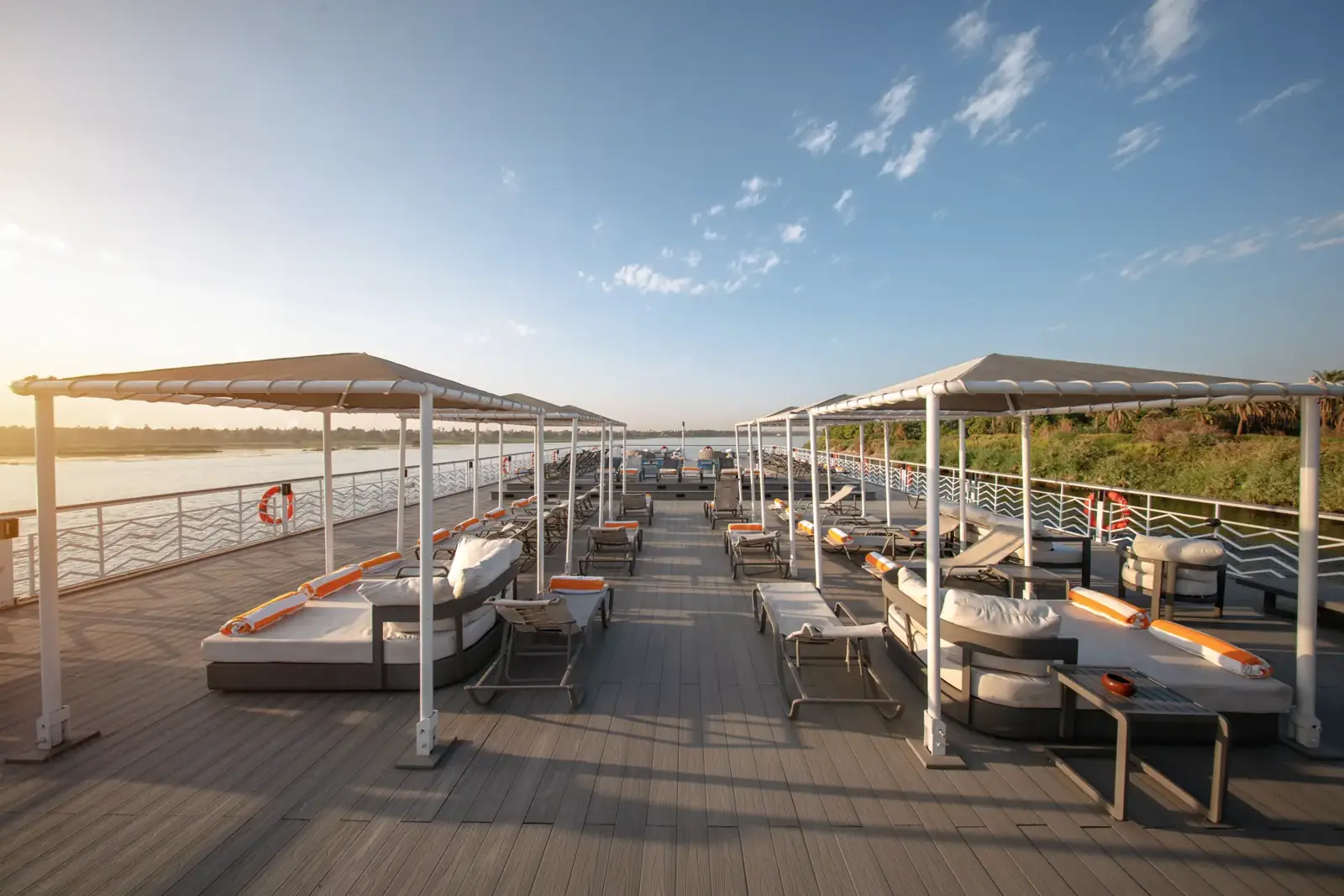
In Luxor the Sun stands about 82° high at maximum eclipse, almost overhead. That makes projection easy: hold a card or colander up and the crescents fall almost straight down onto the deck below. A sheet of white paper on the floor gives a clearer image. Our tours watch from the open sundeck of the Amada Nile cruise; see the four eclipse tours.
Better still: glasses plus projection
Projection is a good backup and a fun way to share the partial phases with a group, but certified glasses let you see the Moon's disk crossing the Sun directly. Read how to check that eclipse glasses are safe, and what you will see during totality once the glasses come off. For the full safety guide, go to watching and photographing the eclipse safely.
Sources: NASA, Eclipse Viewing Safety; AAS, How to View a Solar Eclipse Safely; AAS, Pinhole and Optical Projection; AAS, How to Tell If Eclipse Glasses Are Safe; timeanddate.com, Luxor eclipse 2 August 2027.
Questions
Can you look at a solar eclipse without glasses?
Are sunglasses safe for watching an eclipse?
Does a pinhole projector work during totality?
Keep reading
How to Photograph a Solar Eclipse With a Phone, Safely
Put a proper solar filter over your phone lens for the partial phases and take it off only during totality. Then shoot wide: the darkening sky and…
Read →
Eclipse Glasses: How to Check They Meet ISO 12312-2
Safe eclipse glasses meet the ISO 12312-2 international standard and come from a manufacturer that has had them tested by an accredited lab. A logo…
Read →
2026 vs 2027 Solar Eclipse: Which Is Better?
The total solar eclipse of 2 August 2027 is the better one by almost every measure: nearly three times longer than the 12 August 2026 eclipse, with…
Read →Ask for availability
Tell us your dates and how many are travelling. Nut Travel's eclipse team replies by e-mail or WhatsApp.



Maria, Assem, Nouran or another planner in our Cairo team replies to your request.